How to Identify Common Microcircuit Failures
12/30/2025
Building Your First Microcircuit: A Beginner’s Guide
12/30/2025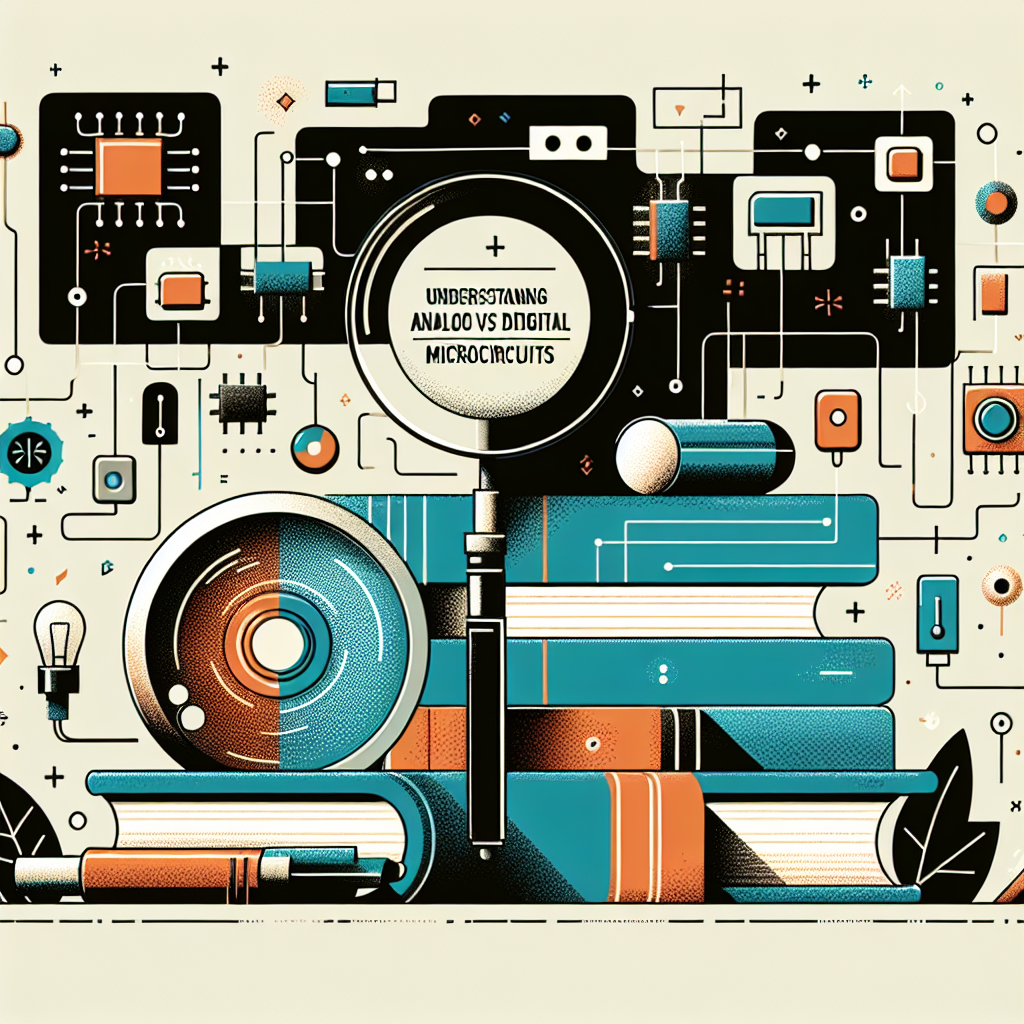
Understanding Analog vs Digital Microcircuits
Introduction
Microcircuits play a crucial role in modern electronic devices, serving as the backbone of technology we rely on daily. Understanding the difference between analog and digital microcircuits is essential for anyone involved in the design, repair, or development of electronic systems. This article aims to clarify these differences, offering practical insights for beginners and intermediate readers alike.
What are Analog Microcircuits?
Analog microcircuits process continuous signals, representing varying quantities. The output signal in an analog circuit can take any value within a given range, making them ideal for applications where precise signal representation is necessary.
Characteristics of Analog Microcircuits
- Continuous Signals: They handle signals that change smoothly over time.
- Signal Processing: Often used in audio equipment, sensors, and amplifiers.
- Variable Resistance: Components like resistors and capacitors are crucial for their operation.
Common Applications
Analog microcircuits are widely used in various applications, including:
- Audio amplifiers
- Radio frequency devices
- Temperature sensors
- Analog signal modulation
What are Digital Microcircuits?
Digital microcircuits, in contrast, process discrete signals that represent data in binary form (0s and 1s). These circuits are designed for high-speed processing and are commonly found in computers and digital devices.
Characteristics of Digital Microcircuits
- Discrete Signals: Signals are represented by two states, high (1) and low (0).
- Higher Noise Immunity: They are less affected by electrical noise compared to analog circuits.
- Complex Functions: Capable of performing complex logic functions and computations.
Common Applications
Digital microcircuits are integral in various fields, such as:
- Computers and laptops
- Smartphones and tablets
- Microcontrollers and microprocessors
- Digital signal processors (DSPs)
Key Differences Between Analog and Digital Microcircuits
Understanding the distinctions between analog and digital microcircuits is crucial for anyone looking to work with them. Here are some key differences:
- Signal Type: Analog uses continuous signals, while digital uses discrete signals.
- Accuracy: Analog circuits can provide more accurate representations of real-world phenomena, whereas digital circuits offer precision in computations.
- Complexity: Digital circuits can handle more complex tasks, whereas analog circuits are simpler but more limited in functionality.
Common Mistakes to Avoid
When working with microcircuits, understanding the differences can help prevent costly errors. Here are some common mistakes to avoid:
- Using analog components in digital circuits without proper conversion.
- Overlooking the need for signal conditioning in analog applications.
- Neglecting to account for noise in analog signal processing.
Benefits of Understanding Both Types
Knowledge of both analog and digital microcircuits offers numerous advantages:
- Enhanced troubleshooting skills for repair and diagnostics.
- Improved design capabilities for hybrid systems combining both types.
- Greater versatility in handling various electronic projects.
Conclusion
Understanding the differences between analog and digital microcircuits is essential for anyone involved in electronics. Each type has unique characteristics, applications, and advantages. By mastering these concepts, you can enhance your skills in microcircuit design, repair, and development. Whether you are building a simple circuit or working on complex systems, this knowledge will be invaluable as you navigate the world of electronics.